

Heavy Duty Conveyor Belts for Mining Industry Buying Guide 2025
2025-12-08 09:57
Choosing the right Heavy Duty Conveyor Belts for Mining Industry keeps your work safe from expensive stops and dangers. You need to follow strong safety rules and pick belts that fit your site’s materials and place. Picking the wrong belt can cause breaks, hurt people, and lose money. This guide gives you useful tips to help you make smart choices for your mining work in the future.
Key Takeaways
Picking the right conveyor belt helps keep people safe. It also lowers the chance of accidents. Always choose belts that follow safety rules for your mining site.
Buying the right conveyor belt can help you save money. It cuts down on work stoppages. It also makes the belt last longer and uses less energy.
Checking and fixing your conveyor belt often stops big problems. Look for damage to keep things working well.
Know what your materials need. Match the belt to the weight, size, and feel of what you move.
Pick a trusted manufacturer. Look for belts that last long, can be changed to fit your needs, and have good customer help. This makes sure you get a good product.
Key Benefits of the Right Conveyor Belt
Cost Efficiency & ROI
You want your mining work to run well and save money. The right conveyor belt helps you spend less in many ways. If you pick Heavy Duty Conveyor Belts for Mining Industry that fit your job, you have fewer sudden stops and longer times between fixes. This means your belts last longer and break less often. You also use less energy, so you save money every day. The table below shows how the right belt can change your costs:
Making a smart choice gives you more value for your money. You pay less for repairs and new belts, and your machines work better for longer.
Safety & Compliance
Safety is very important in mining. The right conveyor belt helps stop accidents and keeps you following safety rules. Many injuries happen when workers use the wrong belt or skip safety steps. For example:
In 2021, a miner died from the return idler of a conveyor belt under a portable crusher during maintenance.
One mine worker died after not using lockout tagout steps, which led to getting caught in the machine.
Many problems come from bad maintenance, not enough training, or broken safety systems.
If you do not use good safety steps, conveyor systems can cause bad injuries, long stops, and trouble with OSHA rules.
You keep your team and business safe by choosing belts that meet safety rules and fit your site.
Operational Uptime
You want your mining work to keep going without stops. The right conveyor belt keeps things moving. Regular checks help you find problems early. Fixing things fast stops small problems from getting worse. Monitoring systems tell you what is happening right now, so you can fix things before they break. Here are some ways the right belt helps you work more:
Regular checks find problems early.
Fast repairs stop big breakdowns.
Monitoring systems help you act quickly.
Belt tension is not just a simple check—it is a key part that affects how the belt moves, how well materials move, how long drive parts last, and how much money your operation makes.
Planning ahead lets you fix things before they break and avoid emergency stops. Your work stays safe and keeps going.
Heavy Duty Conveyor Belts for Mining Industry: Types & Uses
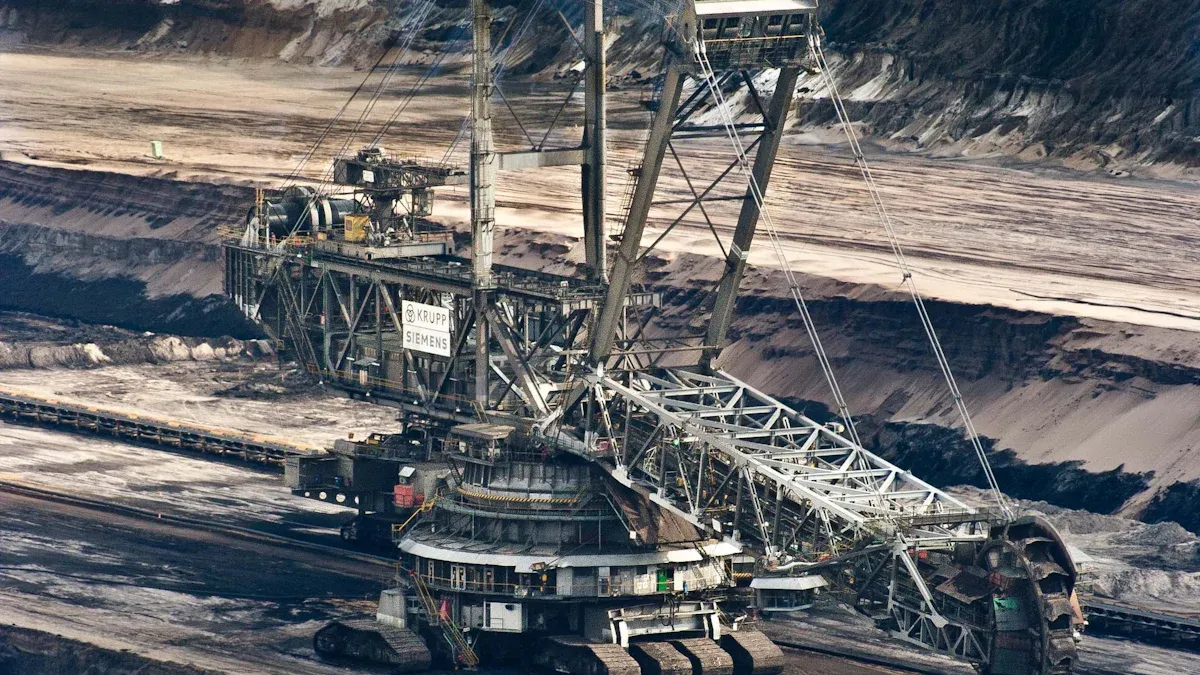
When you pick Heavy Duty Conveyor Belts for Mining Industry, you should know the main types. Each type works best for certain mining jobs. Every belt has its own strengths for moving materials safely and well.
Steel Cord Belts
Steel cord belts are the strongest and last the longest. You use these belts to move heavy things far away. The steel cords inside stop the belt from stretching or bending. This means you do not need to fix them as much. These belts work great in hard mining places. They are good for deep troughing, so materials do not fall off. You can use smaller drive rollers with these belts. This makes your system smaller and easier to fit.
Fabric Belts
Fabric belts have layers of textile material for strength and flexibility. You choose these belts for medium jobs or when you need a belt that bends easily. Multi-ply belts, like Superfort or Fenner Dunlop Ultra X, last long and take hits well. You see fabric belts in both underground and surface mining. They help move big materials and keep your work running well.
Solid Woven Belts
Solid woven belts are best for underground mining. They have strong tensile strength and do not tear easily. These belts also handle hard hits very well. They protect you from fire, which is important underground. The self-extinguishing feature helps you follow safety rules. The table below shows why solid woven belts are special:
Specialty Belts
Specialty belts fix special mining problems. You use them where it is hot, sticky, or there are strong chemicals. For example, SR 25 Red Silicone belts work in heat-sealing and food jobs. Multi-Temp belts are good for cold rooms and freezers. Tev Tex belts move sticky things like candy or glue. Specialty belts help you pick the right belt for your needs. This gives you better safety and performance.
Tip: Always pick the belt type that matches your mining place. This helps you follow safety rules and keeps your work running well.
Heavy Duty Conveyor Belts for Mining Industry come in many types. You can choose the best belt by knowing what each type does.
Product & Material Considerations
Product Characteristics (Weight, Size, Texture)
Think about what you want to move on your conveyor belt. The weight, size, and texture of your materials matter a lot. Heavy things need strong belts with extra support. Lighter things can use belts made from lighter stuff. If your materials are rough or sharp, you need a belt that does not wear out fast.
Here is a table to help you pick the right belt for your material:
If you move big, heavy rocks, use a rubber or fabric-reinforced belt. These belts last longer and do not break easily. For small, light things, a PVC or polyurethane belt is a good choice. Always check if your material is sharp or rough. Weak belts can wear out quickly if the material is rough.
Environmental & Mining Conditions
Mining places can be very tough on belts. You need to think about weather, water, and chemicals. These things can hurt your conveyor belt if you do not pick the right one.
Weather Conditions: Very hot weather can dry out and crack belts. Cold weather can make belts stiff and easy to break.
Humidity and Moisture: Water can make belts weak and cause metal parts to rust.
Sunlight Exposure: Sunlight can make rubber belts hard and not last long.
Corrosive Materials: Chemicals like acids can damage your belt and metal parts.
Tip: Always check your mining site for these problems before you choose a belt. This helps you stop your belt from breaking early and keeps your work going.
Material Suitability (Impact, Heat, Chemicals)
You need a belt that can handle hard jobs in mining. Some belts are better for heavy hits, heat, or chemicals. Steel cord conveyor belts are very strong and do not tear easily. These belts have steel wires inside for extra power. If you move hot things, pick a heat-resistant belt. These belts can work in heat up to 200 °C and protect against damage from heat and chemicals.
For jobs with lots of impact, like dropping heavy rocks, use belts made with UHMW-PE, nylon, or Kevlar®-reinforced rubber. These materials take in energy and do not wear out fast. If you work with oils or acids, pick oil-resistant or acid-alkali resistant belts. These belts last longer when chemicals are around.
When you pick a belt that matches your mining job, you get better results and fewer problems. Heavy Duty Conveyor Belts for Mining Industry come in many types, so you can always find one that works for your site.
Belt Specifications & Site Needs
When you choose conveyor belts for mining, you need to match the belt’s specifications to your site’s needs. This helps you work safely, meet rules, and keep your operation running smoothly. Always check that your belt meets or exceeds all safety standards for mining.
Tensile Strength & Load
Tensile strength shows how much force your belt can handle before it breaks. In mining, you often move heavy loads over long distances. You need a belt with high tensile strength to avoid stretching or snapping.
For mining or heavy industrial uses, look for conveyor belts with tensile strength values of at least 500 N/mm.
High tensile strength means your belt can carry more weight and last longer.
To figure out how much your belt can carry, follow these steps:
Find the load cross-sectional area (A). For a flat belt, multiply the width by the average height of the material. For a troughed belt, calculate the area using the shape made by the idlers.
Measure the belt speed.
Find the bulk density of your material.
Use these numbers to calculate the capacity in tons per hour (TPH).
Tip: Always use the right units when you calculate load capacity. This helps you avoid mistakes and keeps your operation safe.
Abrasion & Tear Resistance
Mining is tough on conveyor belts. Rocks and sharp materials can wear out or tear your belt. You need a belt that resists abrasion and tearing to keep your system running.
EN ISO 14890 gives three categories for abrasion resistance: H, D, and L.
DIN 22102 uses Y, W, and X to show how well a belt resists wear:
DIN Y (ISO 14890 L): For normal service.
DIN W (ISO 14890 D): For high abrasive wear.
DIN X (ISO 14890 H): For resistance to wear, cutting, impact, and gouging.
ISO 4649 and DIN 53516 test how much material a belt loses from abrasion.
ISO 505:2017 measures tear strength in textile belts.
Pick a belt that matches your mining job. If you move sharp or rough materials, choose a belt with high abrasion and tear resistance.
Width, Thickness, Length
The size of your conveyor belt affects how well it works. You need to pick the right width, thickness, and length for your mining site.
Note: Always check your site’s needs before you pick the belt size. The right size helps you move materials safely and efficiently.
Fire & Chemical Resistance
Mining sites, especially underground, need belts that resist fire and chemicals. Fires can start quickly and spread fast. Chemicals can damage belts and cause failures.
Conveyor belts for underground mining must meet strict fire resistance ratings. Federal rules require fire-resistant belts. The schedule 2G fire resistance test is a common standard. However, this test does not always show how belts will perform in real mine fires. Some materials, like neoprene and PVC, may pass the test but still have problems in real conditions.
Always ask for belts that meet or exceed fire and chemical resistance standards for your site. This keeps your team safe and helps you follow the law.
Meeting Safety Standards and Matching Site Needs
You must make sure your conveyor belts meet all safety rules. In the USA, OSHA and ANSI set the main standards for conveyor safety. Key requirements include:
Guarding moving parts to prevent injuries.
Emergency stops for quick shutdowns.
Regular maintenance and worker training.
Certified testing builds trust in your safety systems. You should always ask for proof that your belt passed these tests.
When you match belt specs to your mining site, focus on:
Safety: Use guarding, emergency shut-offs, and train your team.
Reliability: Pick strong belts and keep them in good shape to avoid downtime.
Efficiency: Choose the right speed, width, and loading design to move more material and save energy.
Remember: The right belt keeps your operation safe, reliable, and efficient. Always check specs, safety standards, and your site’s needs before you buy.
Choosing Heavy Duty Conveyor Belts for Mining Industry
Evaluating Top Manufacturers
You want to pick a company you can trust. Not every company gives you the same quality or service. When you look for the best supplier, check some important things.
You should ask about all these things before you buy. A good company will answer your questions and show proof of their quality.
Comparing Features & Support
You need to see what each company gives you. Look at the features, the warranty, and the help you get. Some companies give longer warranties or better support after you buy. Here is a table to help you see the differences:
You should also know how to get help if something goes wrong.
Custom Made Conveyor Belting gives a 90-day warranty for their services.
Rentone Belt wants you to call customer service for warranty help.
Conveyor Technologies Ltd. wants you to write to them and get a return number.
MHS Conveyor needs you to tell them right away if you have a problem.
If you look at these details, you can pick the best Heavy Duty Conveyor Belts for Mining Industry for your site. Good support and a strong warranty help you feel safe about your choice.
Design & Maintenance Tips
Installation & Alignment
You must install and line up the conveyor belt the right way. This helps the belt work well and last longer. If you set up the frames and pulleys carefully, you stop the belt from moving off track or getting hurt. Use a checklist to help you do each step. Here are some good ways to set up your belt:
Tip: Teach your team how to set up and line up the belt the right way. This stops the belt from breaking too soon.
Routine Inspection
You should look at your conveyor belt often to find problems early. Check the belt every day and every week. This helps you fix things before they get worse. Use this table to plan your checks:
If you check your belt often, it will be safer and last longer. Write down what you find and fix small problems fast.
Troubleshooting & Upgrades
When you see a problem, fix it right away. Some common problems are the belt moving off track, slipping, or material sticking to the belt. Here are some quick ways to fix these problems:
Note: Using better belts or adding sensors can stop problems before they start and make things safer.
If you follow these tips, your conveyor will break down less and work better every day.
You can choose the right heavy duty conveyor belt for mining by following these steps:
Pick a belt material that matches your job’s needs.
Check the belt’s width and length for your products.
List the weight and size of what you move.
Make sure the belt fits your incline or decline setup.
Think about the environment at your site.
When you talk to conveyor belt experts, you gain these long-term benefits:
After reading this guide, you should understand product specs, seek technical support, and check supplier reviews. Use these tips to make smart, safe choices for your mining operation. For the best results, reach out to industry experts for advice or a quote.
FAQ
What is the best way to choose the right conveyor belt for my mining site?
Think about what you are moving. Check your site’s weather and safety rules. Make sure the belt is strong enough for your job. Ask experts if you are not sure.
How often should I inspect my conveyor belt?
Look at your conveyor belt every day for damage you can see. Check it every week for bigger problems. Regular checks help you spot trouble early and keep things safe.
Can I use the same belt for underground and surface mining?
No, you cannot use one belt for both jobs. Underground mining needs belts that do not catch fire. Surface mining needs belts that do not wear out fast. Always pick a belt made for your mining place.
What safety standards must my conveyor belt meet?
You need to make sure your belt follows these rules before you use it.