

Heavy-Duty Industrial Rubber Conveyor Belts: Technical Specs & Solutions
2025-12-20 10:47Engineered for Extreme Conditions:
In mining, cement clinker transport, or port handling, conveyor belts are not just rubber products, but a decisive factor in production efficiency. Liaoning hengyi specializes in providing high-performance industrial conveyor belts, designed to withstand abrasion, high temperatures, oil contamination, and high-tension impacts. We strictly adhere to DIN 22102 and ISO international manufacturing standards, ensuring that every meter of belt delivers long-lasting performance in harsh environments.
Abrasion Resistant General Purpose Conveyor Belts:
Suitable for: Quarries, sand and gravel aggregates, ores, coal.
For most industrial bulk material handling, abrasion is the number one enemy. We offer different grades of cover rubber to balance cost and durability.
Technical Specifications (DIN 22102 Standard):
DIN-W (Ultra Abrasion Resistant Grade):
Abrasion Loss: ≤ 90 mm³.
Applications: Extremely abrasive environments, such as granite, basalt, and sharp heavy objects like metal ores.
DIN-X (High Abrasion Resistant General Purpose Grade):
Abrasion Loss: ≤ 120 mm³.
Applications: Coal mines, hard rock, crushed stone, balancing cut resistance and abrasion resistance.
DIN-Y (Standard Abrasion Resistant Grade):
Abrasion Loss: ≤ 150 mm³.
Applications: Coal, sand, cement raw materials, and other moderately abrasive materials; a cost-effective choice.
Tensile Strength: Cover rubber strength ≥ 20-25 MPa.
Elongation at Break: ≥ 400% - 450%.
Heat Resistant Conveyor Belts:
Suitable for: Cement plant clinker, steel plant sinter, asphalt mixing plants.
High temperatures can cause ordinary rubber to harden, crack (Elephant Skin), and eventually delaminate. Our heat-resistant belts use special EPDM (ethylene propylene diene monomer) or SBR (styrene-butadiene rubber) formulations to resist thermal aging. Heat Resistance Rating and Operating Temperature Parameters:
T1 Class (HR-100):
Continuous operating temperature: ≤ 100°C (peak 120°C)
Applications: Cement products, fly ash.
T2 Class (HR-125):
Continuous operating temperature: ≤ 125°C (peak 150°C)
Applications: Coke plants, fertilizers.
T3 Class (HR-150 / HR-180):
Continuous operating temperature: ≤ 150°C (peak 180°C)
Applications: Cement clinker, sintered ore.
Super-Heat (Extreme High Temperature Resistance):
Peak temperature resistance: Up to 220°C - 400°C.
Structure: Usually combined with steel mesh or special fiberglass layers to prevent high-temperature breakdown.
Carcass Specifications:
We offer two core carcass structures to meet the needs from short-distance to long-distance conveying.
1. Multi-layer Fabric Core (Fabric - EP/NN).
Material: Polyester (EP) for low elongation in the warp direction, Nylon (NN) for high elasticity in the weft direction.
Number of layers (Plies): 2 layers - 6 layers.
Strength Rating:
EP200 - EP630: Light to medium duty applications.
EP800 - EP1600: Heavy-duty applications.
EP2000+: Super heavy-duty applications.
Width range: 400mm - 2400mm.
2. Steel Cord Core (Steel Cord - ST).
Advantages: Extremely low elongation (< 0.25%), suitable for long-distance (>1km) and high-tension conveying.
Strength Rating: ST630 to ST5400 (indicating a tensile strength of 5400N per millimeter of width).
Safety Factor: Usually designed at 6.7 - 7.0 times.
Special Industrial Protection:
1. Oil Resistant Conveyor Belts (MOR/SOR).
Pain Point: Used for conveying oily waste, recycled materials, wood processing, or petroleum coke. Ordinary rubber expands in volume by more than 50% when exposed to oil.
Technical Standards:
MOR (Medium Oil Resistant): Suitable for wood chips and waste recycling. Volume change rate < 10% (IRM 902 oil test).
SOR (Super Oil Resistant): Suitable for oil-impregnated materials. Volume change rate < 5%.
2. Fire Resistant & Anti-Static.
Safety Standards: Complies with ISO 340 (combustion test) and ISO 284 (conductivity).
Parameter Indicators:
Roller Friction Test: Roller surface temperature < 325°C.
Burning Time: After removing the fire source, the average afterglow time < 3 seconds (specific grade).
Surface Resistance: < 3 x 10⁸ Ω (prevents electrostatic sparks).
Applications: Coal mines, power plants, fertilizer plants.
Inclined Conveying Solutions:
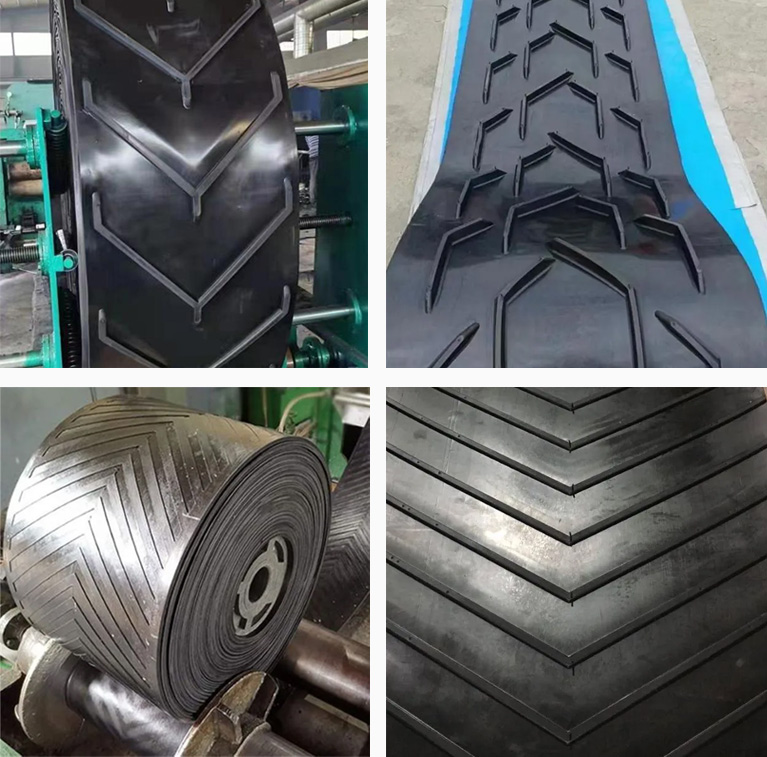
When the conveying angle exceeds 20°, smooth belts cannot grip the material. We offer improved solutions with physical structures:
Chevron Belts:
Pattern Height: 15mm, 25mm, 32mm (C15, C25, C32).
Pattern Shape: Open V-shape, closed V-shape, U-shape.
Maximum Inclination: Up to 45°.
Belt Width: 400mm - 1600mm.
Sidewall Conveyor Belts:
Structure: Base belt + Sidewall + Cleat.
Sidewall Height: 60mm - 400mm.
Maximum Inclination: 90° vertical lifting.
Capacity: Compared to ordinary belts, the capacity is increased by 4 times in the same footprint.
Frequently Asked Questions and Technical Support (Industrial FAQ).
Q: How do your steel cord conveyor belts prevent corrosion?
A: We use galvanized treatment on the surface of the steel cords and a special core rubber compound to ensure that the adhesion between the rubber and the steel cords (pull-out strength) exceeds international standards, completely preventing moisture penetration.
Q: Can you customize endless belts?
A: Yes. We can perform hot vulcanization splicing before shipment based on your conveyor length (C-to-C distance), or provide open-ended belts with corresponding cold bonding/mechanical fastener solutions.